When parents begin exploring speech therapy options, many come across the term gestalt language processing. You may also see clinicians describing themselves as using a gestalt approach or being trained in gestalt language processing.
As highlighted by organisations such as American Speech-Language-Hearing Association, understanding a child’s language profile requires careful assessment rather than relying on a single framework.
If you are specifically looking for this approach, it is important to understand what it means, how it applies to your child, and how to make an informed decision about whether it is the right fit.
What is Gestalt Language Processing?
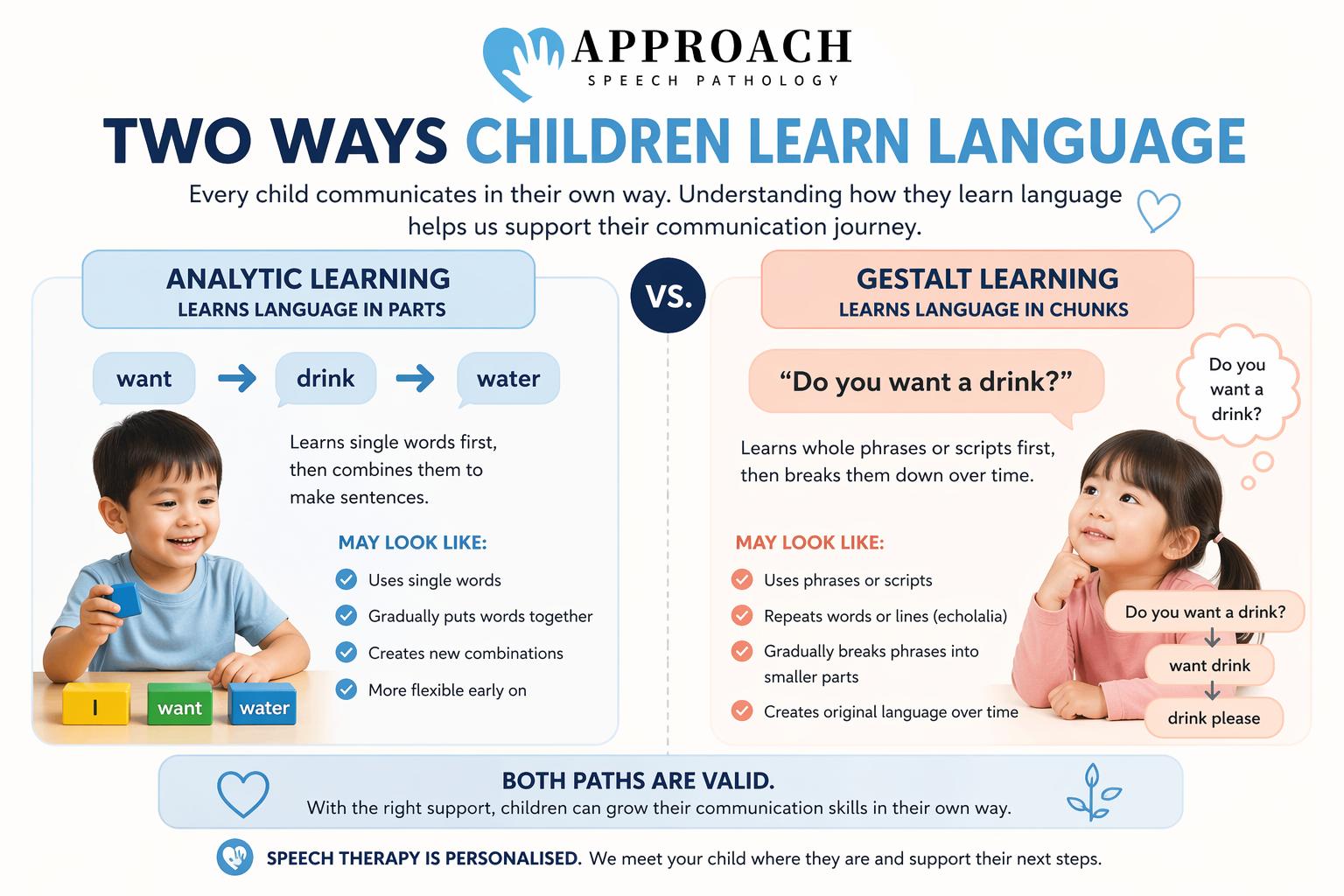
Gestalt language processing (GLP) refers to a way some children learn language in larger “chunks” rather than single words.
For example, instead of learning individual words like “want” or “drink,” a child might learn and use a full phrase such as:
- “Do you want a drink?”
- “Let’s go outside”
- Lines from songs, shows, or familiar routines
These chunks are often called gestalts. Over time, some children may begin to break these down into smaller, more flexible language.
This pattern is commonly discussed in relation to children who:
- Use echolalia (repeating phrases they have heard before)
- Are autistic or neurodivergent
- Prefer predictable, familiar language patterns
What is the Gestalt Approach in Speech Therapy?
A gestalt approach in speech therapy focuses on:
- Understanding the meaning behind your child’s phrases
- Supporting communication through familiar language
- Gradually helping children develop more flexible and original language
You may hear about the Natural Language Acquisition (NLA) framework, which outlines stages of how children might move from using full scripts to generating their own sentences.
Some families are drawn to this approach because it:
- Feels more natural and child-led
- Validates echolalia as meaningful communication
- Aligns with neuroaffirming practice
Is Gestalt Language Processing the Right Approach for My Child?
This is one of the most important questions — and there is no one-size-fits-all answer.
While some children do show patterns consistent with gestalt language learning, not all children learn this way.
A comprehensive assessment by a qualified speech pathologist is essential to:
- Understand your child’s individual communication profile
- Identify strengths and areas of need
- Determine which therapy approaches are most appropriate
It is important to know that:
- Not all children who use echolalia are “gestalt language processors”
- Some children benefit from a combination of approaches
- Therapy should always be tailored to the individual child, not just one framework
What Does the Evidence Say?
Gestalt language processing is widely discussed in clinical and online spaces, and many speech pathologists have observed patterns that align with this framework.
However, current research evidence is still developing. According to American Speech-Language-Hearing Association, evidence-based practice in speech pathology involves integrating:
- The best available research evidence
- Clinical expertise
- The values and preferences of the child and family
You can read more about this framework here:
https://www.asha.org/research/ebp/evidence-based-practice/
At present, while clinical experience and parent perspectives support GLP-informed strategies, high-quality research comparing this approach to others is still limited.
This does not mean the approach is ineffective. It means that careful, individualised clinical reasoning is essential.
What is a Certified Speech Pathologist in This Area?
You may see clinicians describe themselves as:
- “Gestalt-trained”
- “NLA-trained”
- “Certified in gestalt language processing”
Currently, there is no single universally regulated certification standard specific to GLP.
What matters more is whether your speech pathologist:
- Is fully qualified and registered to practice
- Uses evidence-based principles in their clinical work
- Can explain their reasoning clearly and transparently
- Tailors therapy to your child, not just one approach
What Should Parents Look For?
If you are considering a gestalt approach, here are some helpful questions to ask:
- How do you assess whether my child uses gestalt language processing?
- How will you adapt therapy if this approach is not fully effective?
- Do you use other evidence-based strategies alongside this approach?
- How will progress be measured over time?
A good clinician should be able to answer these questions clearly and confidently.
A Balanced Perspective for Parents
It is completely understandable that parents want the best and most suitable approach for their child.
Gestalt language processing offers a meaningful way to understand certain communication patterns. For some children, it can be a helpful framework.
At the same time, therapy should never be limited to one model alone.
The most effective support comes from:
- Individualised assessment
- Flexible, responsive therapy
- Ongoing collaboration between clinician and family
Final Thoughts
If you are exploring gestalt language processing and the gestalt approach, you are already taking an important step in understanding your child’s communication.
The goal is not to find the “perfect” label or approach, but to find the right support for your child at this stage of their development.
Need Support?
If you would like a comprehensive assessment or want to explore whether a gestalt approach is suitable for your child, feel free to get in touch with our team.
We provide tailored, evidence-informed speech therapy that supports both children and families with clarity and care.
Further Reading for Parents
If you would like to explore more about speech and language development, the following resources are helpful:
- American Speech-Language-Hearing Association — Evidence-Based Practice
https://www.asha.org/research/ebp/evidence-based-practice/ - American Speech-Language-Hearing Association — Autism and Communication
https://www.asha.org/public/speech/disorders/autism/ - American Speech-Language-Hearing Association — Late Language Emergence
https://www.asha.org/practice-portal/clinical-topics/late-language-emergence/
These resources provide general guidance and are not a substitute for individual assessment by a qualified speech pathologist.