Why does my child repeat questions instead of answering?
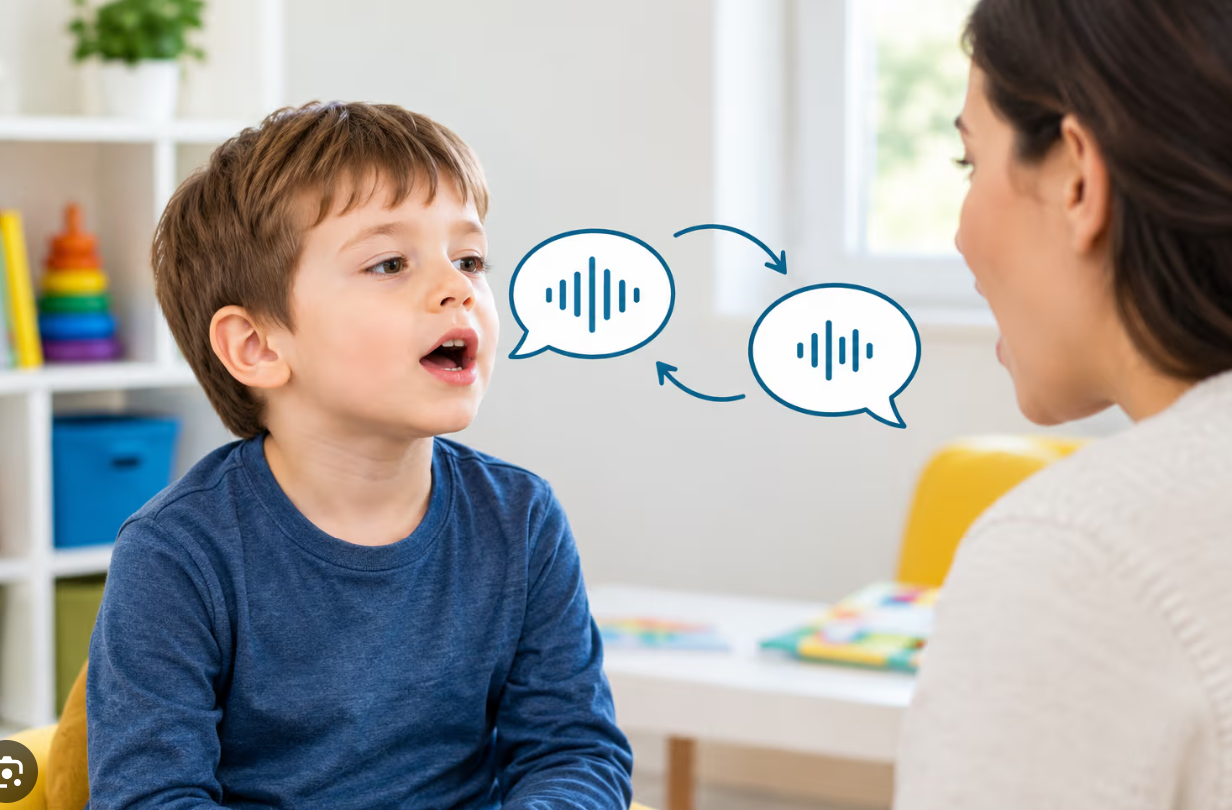
This is the most common version parents notice, and it has a name: immediate echolalia. Your child repeats something straight after hearing it, often word for word, often copying your tone exactly.
It usually means one of a few things.
They need more time. A question is a surprisingly big job. Your child has to hear it, work out what it means, decide on an answer, then find the words. Repeating the question buys a few seconds to do all of that.
They are checking they heard it right. Saying it back is a way of confirming.
They want to take their turn. Your child knows something is expected of them and that it is their turn to talk. Repeating is a way of staying in the conversation when they do not yet have the words for a real reply.
It is practice. Repeating a new word or phrase is how it gets rehearsed. Plenty of toddlers do this with no concerns at all.
Some children repeat only the last word or two of what you said, which can look like they were not listening. It is often the opposite. The last part is simply the bit still available to them.
My child repeats lines from movies and TV shows
This is delayed echolalia. Your child stores a chunk of language they heard somewhere, a show, a song, a video, something you said in the car three weeks ago, and uses it later.
Many parents call this scripting, and that is a perfectly good word for it.
The thing that makes it confusing is that the line often has nothing obvious to do with what is happening. A child might come out with a line from a footy commentary at a birthday party. To you it is random. To your child it may be the language that goes with excitement, so this is the moment for it.
That is the key idea. The chunk usually carries a feeling or a meaning, and the whole chunk works as a single unit, almost like one long word. Your child is not necessarily using the individual words inside it yet.
You may also notice your child watching the same few seconds of a video over and over, going back, playing it again, going back. That is often a child recording something. They are collecting a script.
Is repeating a bad sign?
Usually not, and this is where the research is genuinely reassuring.
The assumption used to be that echolalia was meaningless parroting, something to be discouraged. That changed in the early 1980s. Barry Prizant and Judith Duchan analysed over a thousand utterances from autistic children who repeated a great deal, and found the repetition was doing identifiable jobs: taking a turn, agreeing, protesting, self regulating. They concluded that trying to eliminate it would be unwise, precisely because it was serving a purpose.
A follow up study looked at delayed echolalia, the stored chunks, and found the same thing. Those were doing work, including helping children manage their emotions and join in with others.
So the repetition is not a gap where language should be. It is language, in an early form.
It is also worth saying plainly that echolalia is not unusual. Every one of us does it. Repeating a phone number to yourself to hold onto it, echoing back what someone said at a counter because you did not quite catch it, saying the last few words of a sentence while you catch up on the first part. Same thing.
When one word is really a whole sentence
This one is easy to miss, and it matters.
A child who says "iPad" over and over might not be naming the iPad. They might mean "can I have the iPad". The single word is standing in for the whole message.
From the outside it looks like a child who has one word. What is actually happening is a child who has one word doing the job of a sentence. And because it is only one word, there is nothing inside it for your child to pull apart and reuse somewhere else.
This is why the standard advice, keep it simple, one word at a time, does not always help. For some children it leaves them with a collection of single words that each mean something much bigger, and no way to recombine them.
What tends to help instead is hearing the fuller message modelled. Not asking your child to say it. Just saying it near them, so the words that make up "can I have the iPad" become available as separate pieces.
If you are not sure which of these is happening with your child, that is a reasonable thing to bring to an assessment. It is hard to tell from the outside, and it changes what is worth doing.
What helps at home
Treat it as talking. Respond to the repetition the way you would respond to any attempt to communicate. Even if you have no idea what it means, acknowledging it tells your child that using their voice gets a response.
Become a detective about where it came from. If a phrase keeps appearing, try to find the source. Which show, which conversation, which moment. Once you know where it is from, you can often work out what feeling goes with it, and then you know what your child is telling you.
Turn questions into comments. This is the single change that makes the most difference, and it is harder than it sounds. Instead of "what do you want?", try "I wonder if you want the blue one." Instead of "what's wrong?", try "something's not right." Open questions are genuinely difficult for a child at this stage, and a comment gives them language instead of asking them for it.
Offer choices out loud. When you do need an answer, model the options rather than asking an open question. "I want to go home. I want to play some more." Then pause. Your child will often tell you which one, sometimes by repeating it.
Pause longer than feels natural. A few extra seconds of silence after you speak does a lot of work.
What you might read online, and how we treat it
If you have been searching, you have probably come across the term gestalt language processing, often shortened to GLP, and the idea that children who script are learning language in whole chunks and move through a set sequence of stages before arriving at flexible sentences.
You may also have seen it described as a different but equally valid path to language, rather than a delay.
We want to be straight with you about where this sits.
The part that is well established is the part this article is built on. Repetition is meaningful, it serves real purposes, and discouraging it is not helpful. That has solid research behind it going back forty years.
The staged framework built on top of that is newer and is genuinely debated among speech pathologists and researchers. It has become very popular, many clinicians find it a useful way to think and plan, and it is valued by a number of autistic adults who describe their own language development that way. At the same time, published reviews have questioned whether the stages hold up and have pointed out that the specific recommendations, including labelling a child a gestalt language processor and writing goals against the stages, do not yet have research support (Hutchins and colleagues, 2024).
What that means for you in practice: we will happily talk about these ideas, and your clinician may well use some of them in how they plan. What we will not do is label your child with a processing style and then run a program off that label as though the matter were settled. We would rather look carefully at what your child is actually doing and work from there.
If another clinician has described your child as a gestalt language processor, that is not a problem and it is not wrong. It is a shorthand a lot of people use. It is just worth knowing it is a description, not a diagnosis.
When to get it checked
Repeating on its own, in a toddler who is otherwise building language, is usually not a concern. It tends to be worth a conversation with a speech pathologist when you notice some of the following:
- The repeating is still the main way your child communicates well past the toddler years
- Your child has plenty of memorised phrases but very few sentences of their own
- The same single words appear all day, seemingly meaning different things each time
- Your child cannot answer simple questions, or following instructions is hard
- Your child is starting to avoid talking, or seems frustrated when not understood
- Something else about their development is also on your mind
You do not need a referral to see a speech pathologist privately, and you do not need to be certain anything is wrong. An assessment is information. It tells you what stage your child's language is at, what the repeating is doing for them, and whether starting now or keeping an eye on it makes more sense.
Common questions
Is echolalia a sign of autism?
Not on its own. Repeating is a normal part of how many toddlers learn to talk, and adults do it too. It is more common and tends to last longer in autistic children, and reviews of the research put the proportion of speaking autistic children who use echolalia anywhere between a quarter and almost all of them, depending on how studies defined and measured it (Griffith University review, 2024). The wide range tells you something useful: echolalia by itself is not a reliable indicator either way. It is what sits alongside it that matters.
Should I stop my child from repeating?
No. The research is fairly clear that discouraging it is unhelpful, because the repetition is doing a job. Work out what the job is instead.
Is echolalia in toddlers normal?
Yes, very. It is most noticeable between about one and three, when children are taking in language far faster than they can produce it. For most children it fades as they build their own sentences. A good early sign that things are shifting is when your child starts changing the scripts rather than saying them exactly: "let's sit down" becomes "no, sit down". That small change is a meaningful one.
My child repeats the same word all day. What does that mean?
It may be a whole message in one word, as described above. It can also be self regulating, a word that is calming or satisfying to say. Those two things can be true at once. Noting when it happens and what is going on around your child at the time is genuinely useful information to bring to an appointment.
We speak more than one language at home. Does that change anything?
No, and please do not drop your home language. Several of our clinicians speak Mandarin or Cantonese, and we can arrange an interpreter for other languages. Children can and do script in more than one language.
Next steps
If your child repeats a lot and you would like to understand what it means for them specifically, an assessment is the place to start.
Approach Speech Pathology is a speech pathology clinic based in Mount Waverley, working with children from preschool through to secondary school. We see a lot of children who script, and we will tell you honestly whether therapy now or keeping an eye on things makes more sense.
If you have more questions or want to book an appointment, please click /contact
Where to read more
- Speech Pathology Australia, for finding a certified practising speech pathologist anywhere in Australia
- Raising Children Network, an Australian government funded parenting resource
Reference:
| Prevalence of Echolalia in Autism: A Rapid Review, Griffith University, 2024 |