What does AAC stand for?
AAC stands for Augmentative and Alternative Communication.
You may have heard the terms augmentative communication and alternative communication and wondered what the difference is.
Alternative communication refers to communication methods that may be used when a person cannot reliably communicate through speech. In these situations, AAC provides another way for someone to express themselves. This might be the case for someone who has difficulty producing speech because of physical, structural or functional differences. For example, AAC may be used by someone with a tracheostomy (breathing tube), or by a child with significant motor-speech difficulties associated with cerebral palsy or craniofacial differences.
Augmentative communication, on the other hand, is used to support and add to a person's existing communication. It does not mean that speech needs to be replaced.
This can be particularly helpful for children whose speech is developing, is difficult for others to understand, or may not be reliably available in every situation. AAC may be used alongside speech for autistic children, children with Developmental Language Disorder (DLD), and children who experience situational mutism.
For some autistic children, AAC can provide access to a reliable communication system while their speech and motor-speech skills are developing. This means that even if speech takes time to develop or become easier for other people to understand, your child can still have a reliable way to express themselves.
And importantly, using AAC does not mean giving up on speech.
For children who are developing speech, AAC can be used alongside speech to give them more ways to communicate.
What makes an AAC system robust?
A good AAC system should give your child plenty of opportunities to communicate, instead of only requesting things such as food, toys or help.
A robust AAC system should allow your child to communicate:
“What I want to say, to whoever I want to say it to, whenever I want to say it, however I choose to say it.”
— Gayle Porter
This might include:
- Requesting
- Commenting
- Asking questions
- Protesting
- Telling jokes
- Sharing stories
- Expressing emotions
- Making choices
- Saying “no”
- Having conversations with other people
The goal is for AAC to support real, meaningful communication, rather than simply teaching a child how to make requests.
What types of AAC are there?
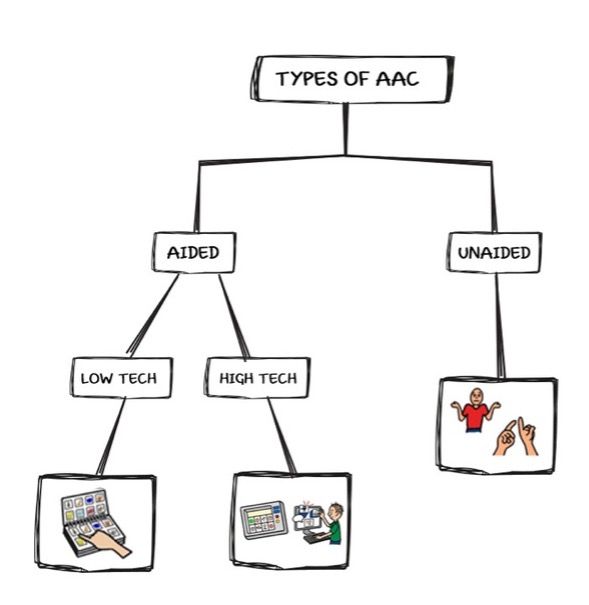
There are many different types of AAC. Broadly, AAC can be divided into two categories: unaided AAC and aided AAC.
Unaided AAC
Unaided AAC does not require a physical device or external communication system. Instead, the person uses their own body to communicate.
This can include:
- Natural gestures
- Facial expressions
- Body language
- Eye gaze
- Key Word Sign
- Sign language (e.g., Auslan)
Sign language can be a very powerful and robust form of communication. However, one consideration is that most people in the community do not understand sign language, which can limit who your child is able to communicate with independently.
Aided AAC
Aided AAC involves using an external tool or system to support communication. This can range from simple, low-tech options through to sophisticated high-tech communication devices.
Low-tech AAC
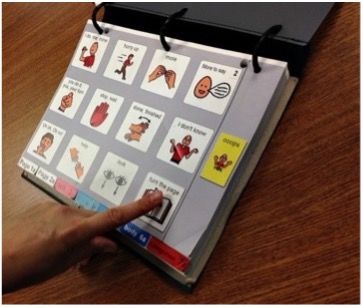
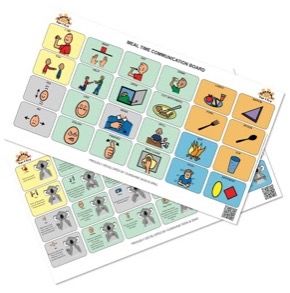
Low-tech AAC does not require batteries or electronic technology, examples include:
- Communication boards
- Communication books
- Alphabet boards for spelling
- PODD books
One of the benefits of low-tech AAC is that it is generally simple to use, doesn't rely on charging or batteries, and can be practical in different environments.
It can also be helpful to have a low-tech AAC backup available, even when your child primarily uses a high-tech AAC system.

High-tech AAC
High-tech AAC systems use technology to support communication.
They can provide:
- Speech output
- Dynamic displays, where vocabulary and pages can change
- Tools for navigating and finding words
- Access to a larger vocabulary
There are many different AAC apps and communication systems available. Some commonly used options include:
- Proloquo2Go
- LAMP Words for Life
- TouchChat with WordPower
- TD Snap, including Core First and Motor Plan options
- High-tech PODD
These systems can be used on an iPad or on a dedicated communication device, depending on your child's individual needs.
Choosing an AAC system can feel overwhelming and there is no single AAC system that is right for every child.
Your speech pathologist can help you explore different options and complete AAC trials to work out which system best matches your child's communication, language, motor and sensory needs.